
Stop. Imagine this. Your client has a new role to be filled, and they want an onboarding course in 6 weeks. Brand new role. There is very little documentation, no prior courses, nothing. But what is the best way to do this onboarding course? Do you want the content to be presented this way or another? This is where rapid prototyping comes in.
Rapid prototyping allows L&D teams to visualise, experiment, and test different ideas in a concrete form using tools like Storyline, Figma, or even pen and paper before committing to full-scale development. Rather than front-loading every design decision, it inverts the process: build a rough model, get real feedback, then refine. It’s the difference between designing in isolation and designing in collaboration.
The concept isn’t new. But AI has fundamentally changed what “rapid” really means.
What Is Rapid Prototyping in L&D?
Rapid prototyping is an instructional design approach that combines the design, development, and evaluation phases into a non-linear process, producing a sample working model; a scaled-down representative version of the whole course.
Think of it as your first functional draft. A prototype doesn’t need to be polished. It needs to be testable. By identifying misalignments early – a “fail fast” approach – teams mitigate the risk of launching ineffective training and reduce costly late-stage rework.
For L&D organisations, this matters because course development cycles are expensive. Research consistently shows that eLearning can reduce training time by 40-60% and generate average savings of 50-70% on training costs but only when the design process itself is efficient. And prototyping goes a long way in design efficiency.
How AI Has Changed the Prototyping Game
Until recently, rapid prototyping in L&D still meant days of work: drafting storyboards, building wireframes, writing scenario copy, sourcing visuals. The execution time between idea and testable asset was the bottleneck squeezing learning designers.
AI has removed that bottleneck. The ATD report found that 37% of talent development professionals say AI tools have greatly reduced course design time, and 70% say it improves the quality of their course design.
Organisations using AI-powered development tools report up to 80% faster content creation, which means more cycles of feedback, more iteration, and ultimately better learning outcomes before a single learner touches the course.
For L&D teams, this shift isn’t just about speed. It’s money. It’s quality. It’s creativity. The L&D professional is presenting three variations ready to test and coming back with faster and cleaner edits as needed. From testing in 6 weeks, it’s testing in one week. AI-powered tools allow L&D teams to generate draft content, freeing up instructional designers to focus on creativity and contextual relevance – the things no AI can replicate.
L&D leaders now need to prepare their teams for this shift by focusing on AI training, data integration, and higher-order skills like critical thinking and problem-solving.
The Best Tools for Rapid Prototyping in L&D Right Now
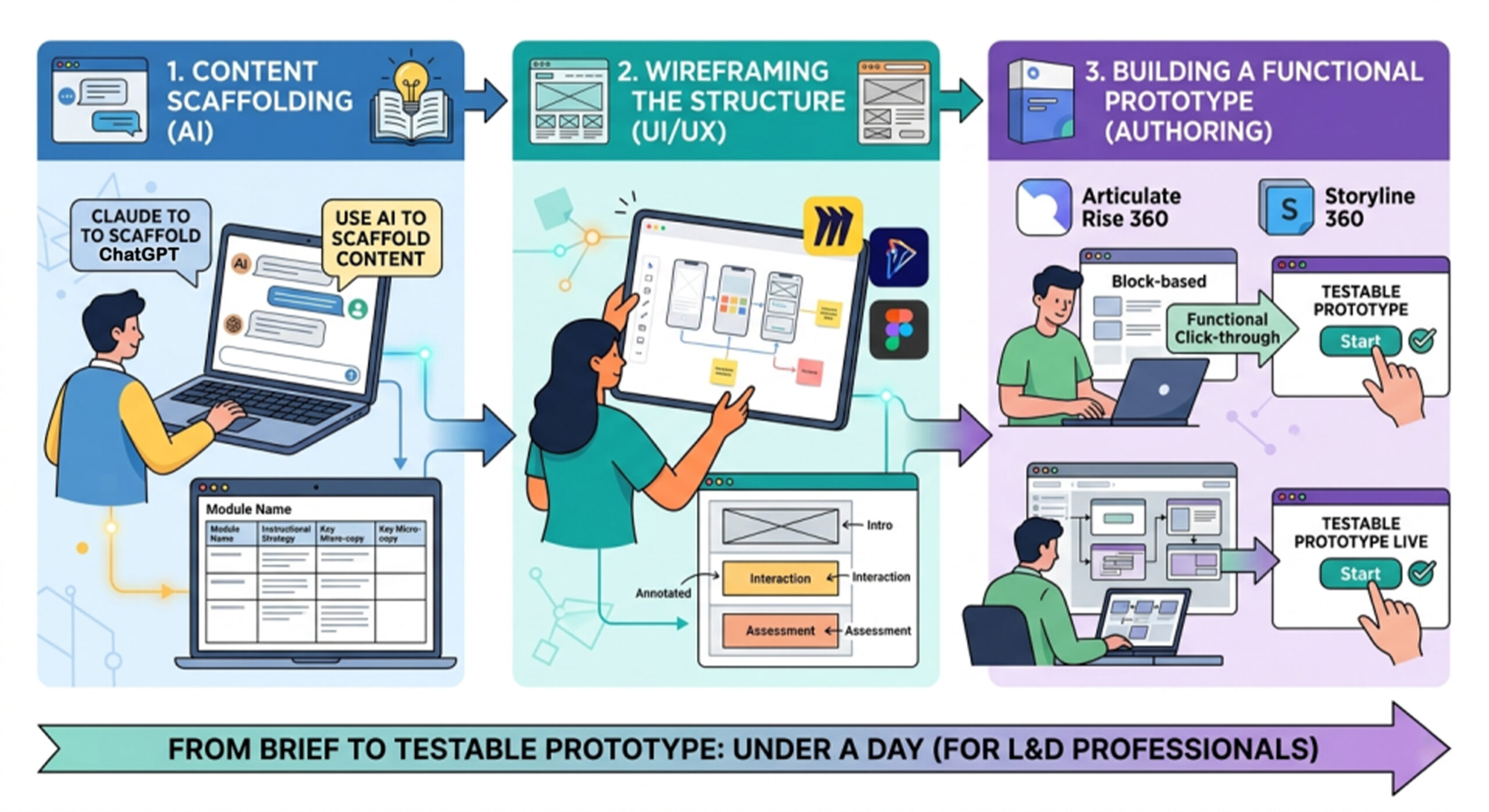
ChatGPT / Claude — for content scaffolding
Use AI to generate course outlines, scenario drafts, quiz questions, and learning objectives in minutes. ChatGPT can create generative narrative text for eLearning storyboards and automate many time-consuming instructional design tasks though it requires a skilled instructional designer to validate and refine the output. Treat it as a really good research assistant – who is available anytime.
Figma / Miro — for visual wireframing and collaboration
Before opening your authoring tool, map the learner journey in Figma or sketch interaction flows in Miro. These tools allow cross-functional teams – L&D, SMEs, stakeholders – to collaborate on prototypes in real time, reducing the number of revision cycles downstream. Figma’s AI features now allow teams to auto-generate UI screens from text prompts, accelerating early visual mock-ups significantly.
Articulate Rise & Storyline — for functional prototypes
Storyline allows L&D teams to build concrete prototypes of interactive activities and navigational frameworks enough to demonstrate learner experience without building the entire course. Articulate Rise is well-known for enabling quick, responsive prototypes that stakeholders can click through on any device, giving them a genuine feel for the final product without the full development investment.
The winning workflow combines all three effectively.
A Call to Action for L&D Organisations
Rapid prototyping isn’t a design technique; it’s an organisational capability. In 2026, organisations are winning in L&D not just with quality but also with time. With AI, more design cycles and faster delivery have both become accessible.
If your team is still spending three weeks on a storyboard before a single stakeholder sees anything, that process is costing you time, budget, and relevance.
Ready to see rapid prototyping in action?
In the episode 6 of The Learning Buzz, Josh Cavalier highlights this need for L&D professionals to evolve with AI and Visakh build a prototype live. This is not a one-off. At Apposite, where we evolve with the technology, we understand how to stay winning.
Tell us about the tools you are working with – and the tools you don’t like.