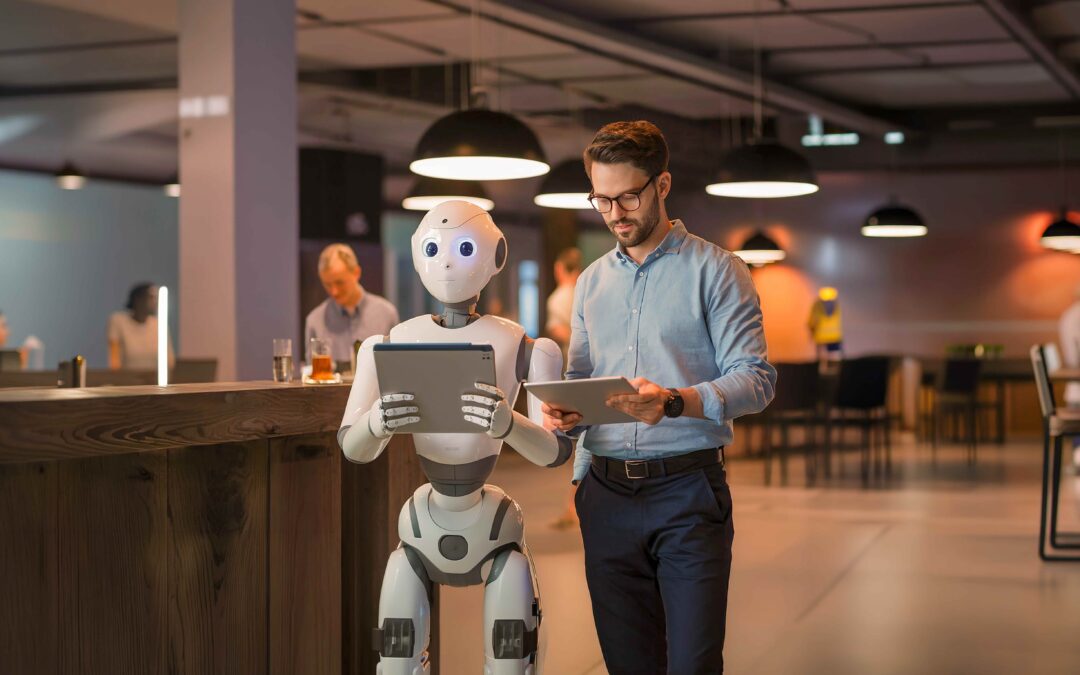
Your new coworker doesn’t take lunch breaks. Doesn’t ask for PTO. Never says, “Just circling back on this.”
It doesn’t steal your office chair. It doesn’t microwave fish in the pantry. Honestly, from an HR perspective, it’s a dream hire.
It’s AI.
And strangely enough, it might also be your best trainer.
If you work in learning and development, HR, or workplace strategy, that sentence should give you pause. Because while L&D teams are still building courses about work, AI is already teaching people inside the work.
That should make us a little uncomfortable.
For years, we’ve talked about “learning in the flow of work” like it was the future. Add a few job aids, embed a checklist in the workflow, maybe throw in a well-timed microlearning module, and voilà…modern learning.
But here’s the problem: we’re still designing learning for a version of work that no longer exists.
And AI didn’t just knock on the door. It moved in, rearranged the furniture, and started answering emails.
We’re Designing Learning for Yesterday’s Job
Most learning strategies still assume a simple sequence:
Leave work → Learn something → Return to work better.
It’s neat. It’s structured. It looks great in a strategy deck. It’s also increasingly fictional.
People are not pausing their workday to complete a 30-minute module before making an important decision. They’re opening ChatGPT during the meeting. They’re asking their AI copilot how to phrase the client email. They’re testing prompts while the deadline is actively judging them.
Learning is no longer a separate activity. It’s happening in the panic between “Can you send this by EOD?” and “Absolutely.” The LMS (learning management system) used to be the main character. Now, it’s giving strong supporting-role energy.
That doesn’t mean formal learning is dead. It means it’s no longer where most learning happens. And if L&D keeps designing for where learning should happen instead of where it does happen, we’re building very beautiful museums.
How AI Is Changing Workplace Learning
A lot of conversations about AI in L&D still sound like this:
“Great, now we can create courses faster.”
That’s like looking at electricity and saying, “Nice, faster candles.”
Yes, AI can help create content faster. Wonderful. Helpful. Necessary.
But that’s the smallest part of the story.
The real shift is this: AI is becoming the place where learning happens.
Sales teams are learning inside CRM copilots. Support teams are picking up new skills through AI prompts mid-conversation with live customers. Managers are being nudged toward better decisions inside the workflow tools they already use every day.
Employees don’t “go learn.” They ask, test, fail, retry, and improve in real time.
Learning is no longer a destination. It’s infrastructure. That changes the role of L&D completely. We’re not just content creators anymore. We’re system designers.
And frankly, that title sounds better on LinkedIn anyway.
Microlearning Isn’t Dead. But It Is Having an Identity Crisis
Somewhere along the way, microlearning became corporate shorthand for:
“Take the same old content and make it shorter.”
A five-minute video.
A seven-slide carousel.
A cheerful voiceover with suspiciously enthusiastic background music.
We called it innovation. It was mostly compression.
Microlearning was never supposed to be about smaller content. It was supposed to be about better timing. The research behind it – Ebbinghaus’s work on memory and forgetting, and decades of instructional design theory from thinkers like Karl Kapp have always argued for relevance, not brevity.
Because in high-speed work environments, relevance beats duration every single time. The future isn’t bite-sized learning. It’s micro-interventions.
Ten seconds. Right moment. Right decision.
Not “Please complete this module before Friday.”
If your learning strategy still starts with “Let’s build a module,” we need to have an urgent conversation. Because learning that interrupts work competes with work. Learning inside work improves it.
That difference matters.
The New Skills Employees Need in the Age of AI
This is where things get interesting. And slightly existential. Increasingly, humans are no longer the primary “doers” of work. AI drafts reports. Automation handles workflows. Robots deliver goods.
Humans?
We supervise. We intervene. We make judgment calls when the machine gets weird.
(And it will. It absolutely will.)
This means the skill gap is changing. It’s no longer just: “Do you know how to perform this task?” It’s now:
Do you know when to trust the system?
When to challenge it?
When to override it?
When to realize the AI is confidently, beautifully wrong?
That’s not a content problem. That’s a judgment problem.
And judgment cannot be trained once and filed away in your brain next to “mandatory compliance training.” It must be continuously supported. Think real-time nudges, reflective prompts embedded in tools, peer feedback loops built into the workflow itself, not a course you revisit annually.
That’s where real learning in the flow of work begins.
The Uncomfortable Questions L&D Needs to Ask
- If AI is making the decision, what exactly are humans learning?
- If your coworker is a machine, what does collaboration look like?
- If work becomes increasingly autonomous, what does onboarding even mean?
These are not distant, futuristic questions. They’re already here. And yet, a surprising amount of L&D energy is still spent debating whether training should be 20 minutes or 10. The real challenge isn’t optimizing content. It’s redesigning the learning environment itself.
Because if AI is becoming part of how people think, decide, and act at work, then learning can’t stay trapped inside a course catalogue. It must live where decisions happen.
The question isn’t whether AI will reshape how your employees learn. It already has. The question is whether L&D will lead that change or just document it.
Maybe L&D Needs Fewer Courses and Better Questions
Maybe the future of learning isn’t better training. Maybe it’s better environments.
Less: “Here’s everything you need to know.”
More: “Here’s what helps you think clearly when the moment arrives.”
Because in the age of AI, information is not the competitive advantage. Everyone has access to information. Your edge is judgment. Discernment. Decision-making. The ability to know when the answer is right and when it just sounds right in a very confident bullet-point format. That doesn’t come from completing modules. It comes from working, reflecting, questioning, and being supported in real time. This means the future of L&D may not be designing courses at all. It may be designing workplaces where learning happens so naturally that people forget it was ever called “training.”
And honestly? That might be the smartest thing AI teaches us.
At Apposite, we help organizations design learning environments where employees build skills inside the flow of work, not outside it. What is your L&D team doing to move learning inside the flow of work?
Share your thoughts and forward this to a colleague rethinking workplace learning.